
Why does my snack go soft after two weeks? Five shelf-life failure mechanisms
A product does not "just spoil". Usually one measurable mechanism is responsible: moisture, oxidation, texture, microbiology or packaging.
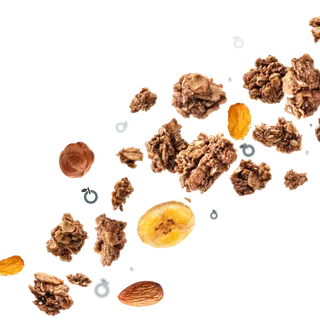
We saw it again this month: excellent granola, precise flavour, a handsome pack. Two weeks on the shelf and it is no longer crisp. In the kitchen and in the lab it was perfect. What happened on the way?
The short answer: almost no product spoils “just because”. In most cases there is one failure mechanism, sometimes two, that can be identified, measured and addressed. The common mistake is to start changing things (a more expensive pack, a preservative, less oil) before knowing what is actually going on.
1. Moisture: uptake and migration
A crisp product is a dry product sitting below its glass-transition temperature. When it picks up moisture from the air, or from a moist component in the same pack (raisins in granola, a filling in a biscuit), its water activity (aw) rises. At some point, typically around aw 0.4 to 0.5 for cereal-based products, it crosses its Tg and softens. The crunch is gone and the product reads as “chewy” or “tired”.
What to measure: the water activity of each component separately and of the whole product, and a sorption curve (what happens to aw at different humidities). What to check in the pack: WVTR, the film’s water-vapour transmission rate.
2. Lipid oxidation
Nuts, fat, oil, fried products and high-fat powders oxidize. The result is a flat, “cardboard” or “paint” note that sometimes only shows up after a month or two. Oxidation is accelerated by oxygen, light, heat, metals and surface area (the finer the product is ground or sliced, the faster it goes).
What to measure: peroxide value and TBARS over time, together with a planned tasting at fixed time points. What to check in the pack: OTR (oxygen transmission), nitrogen flushing, an oxygen scavenger, light barrier.
3. Texture: hardening or softening
Protein bars harden. Bread dries and firms up (starch retrogradation). Gels lose water (syneresis). This is not always about moisture from the environment; sometimes it is a chemical or physical reaction inside the product: protein reacting with sugars, starch recrystallizing, water migrating between phases.
What to measure: texture analysis at time points, with a test that fits the product. A number lets you compare formulations rather than just saying “it got hard”.
4. Microbiology
In products with aw above 0.85, or pH above 4.6, microbial growth is the leading limit. Mould in bread, yeasts in sauces, bacteria in chilled products. Here the hurdles (pH, aw, heat treatment, refrigeration, packaging) have to work together, and accredited testing is done by an external microbiology lab.
5. Packaging that does not do its job
Sometimes the formulation is fine and the pack is not: a leaking seal, a film without enough barrier, too much headspace with oxygen in it, or a transparent pack for a light-sensitive product. A seal-integrity check and a simple headspace-gas measurement save a lot of guessing.
How to start the investigation
Before any change, define:
- The intended shelf life and the storage and distribution conditions.
- What the product looks, feels and tastes like on day zero (numbers, not only words).
- Exactly what failure was observed, and when the product becomes unacceptable.
Then choose measurements that fit the suspected mechanism and run storage under controlled conditions. If the mechanism is clear, accelerated shelf-life testing gives a read within weeks. Real-time storage confirms it.
That is exactly what The Whole Package, our shelf-life and packaging service, does: first understand why, and only then decide what to change. A mistake in the lab costs far less than a mistake on the shelf.

 Talk to us