
Glass transition (Tg) in food: why dry products turn sticky, soft or caked
Why powders cake, snacks go soft and candies stick: what the glass transition (Tg) explains, what it misses, and how to turn it into a moisture and pack spec.

Three complaints that sound unrelated. A fruit powder that ran well in the spray dryer in winter coats the chamber wall in August. A cracker that left the line crisp is leathery by the time it reaches the shelf. A jar of instant coffee turns into a brown crust after a few weeks in a humid kitchen.
All three have the same cause. Each product is a glass, and each one crossed its glass-transition temperature, Tg. Once you know where that line sits for your product, you can design the moisture, the process and the pack around it instead of guessing.
What Tg is
Drying, freezing, extrusion and sugar boiling often remove water or heat too fast for sugars, starches and proteins to arrange themselves into crystals. They lock in place as a disordered, amorphous solid: a glass. Below its Tg the glass is rigid and brittle, and its molecules barely move. Above Tg it turns rubbery: softer and stickier, with molecules that move far more freely.
Tg is not a melting point. No latent heat is involved, the change runs over a range of several degrees rather than at one temperature, and the measured value depends on how fast the sample is heated. That is why a serious Tg result states whether it is the onset or the midpoint of the transition, and the heating rate it was measured at.
Water moves the line
Water is the strongest plasticizer in food. Its own glass transition sits around −135 °C, so every bit of water a dry product absorbs pulls its Tg down, and steeply.
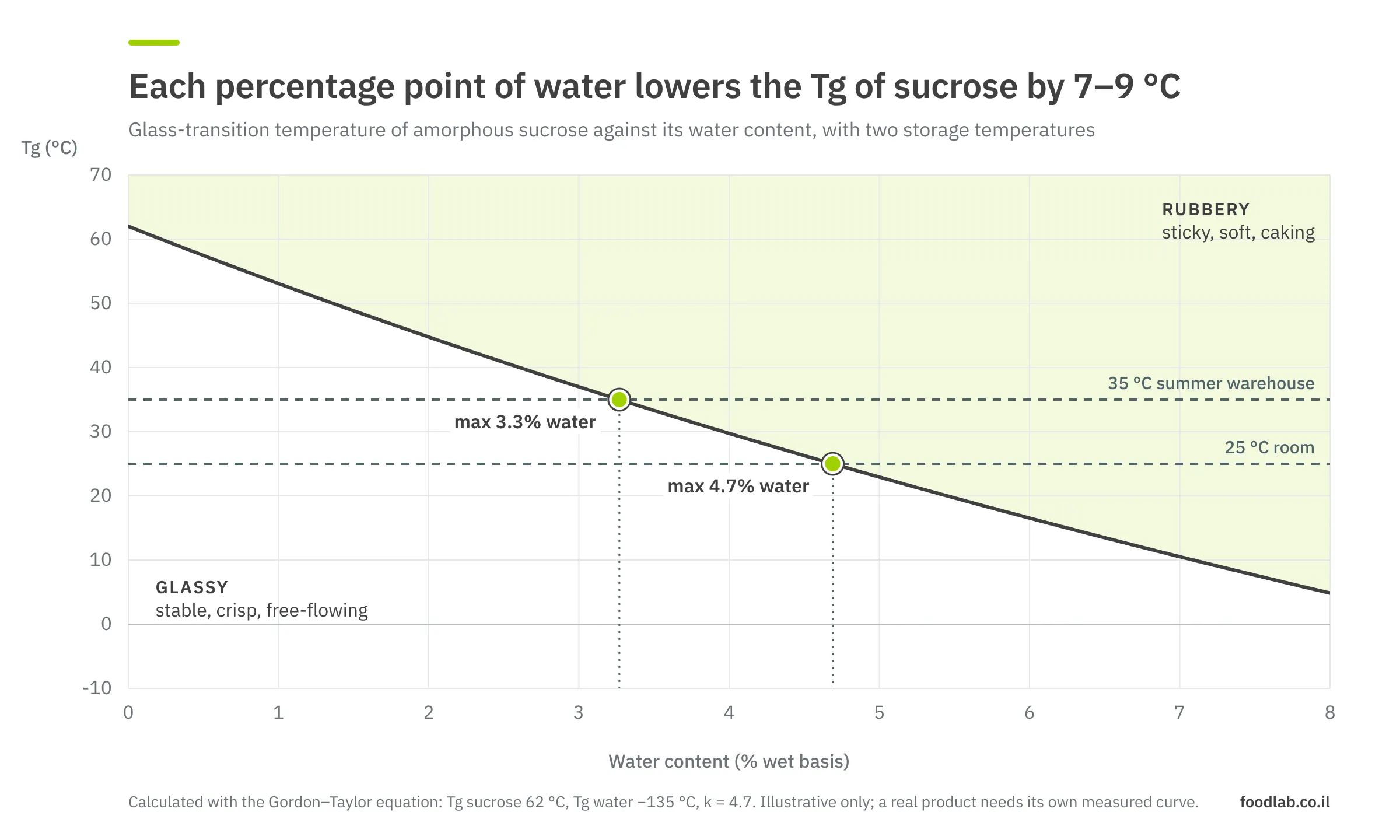
A worked example: dry amorphous sucrose has a Tg of about 62 °C. With 2% water, the Gordon–Taylor equation puts it at about 45 °C. With 4% water, about 30 °C. In this range, every percentage point of moisture costs the sugar glass 7 to 9 degrees of margin. Put the other way round: at 25 °C this glass tolerates about 4.7% water; in a 35 °C warehouse in an Israeli summer, only about 3.3%.
What matters is the distance between the storage temperature and Tg, T − Tg, and its effect does not grow gently. Using the classic WLF constants as an illustration, 10 °C above Tg molecular rearrangement runs several hundred times faster than at Tg itself, and 20 °C above it tens of thousands of times faster. That is why a product can sit unchanged for months and then fail within days of a heatwave or a leaking seal.
Where it shows up
- Spray-dried powders. Fruit sugars (fructose, glucose) have a low Tg, so fruit powders stick to the dryer wall and the yield collapses. In a published pomegranate-juice study, raising DE 20 maltodextrin from 5% to 25% lifted the powder’s Tg from 38 °C to 72 °C and its sticky point from 57 °C to 89 °C. About 20% carrier was needed before more than half the powder was recovered.
- Powders in storage. Milk powders, infant formula, instant coffee and soup mixes cake when particle surfaces cross Tg and fuse. In a 2025 instant-coffee study at 20 °C, unpacked powder held at 11% relative humidity stayed stable, while at 65% it passed its critical moisture within a week and degraded visibly.
- Crisp products. Crackers, wafers, extruded puffs and breakfast cereals lose their crunch when absorbed water pulls their Tg below room temperature. We followed that path in Why does my snack go soft after two weeks?
- Hard candy. A boiled sweet is a sugar glass by design. Too much residual water, or a humid day, and it turns sticky, flows or grains, as sugar crystallizes out of the glass.
- Freeze drying. Here the number that counts is Tg′, the glass transition of the concentrated phase between the ice crystals. During primary drying the product must stay below its collapse temperature, usually a few degrees above Tg′, or the structure shrinks and collapses. More in Freeze drying for food: when it is worth the cost.
- Frozen foods and ice cream. Between the ice crystals sits a concentrated syrup that stays unfrozen. For sucrose, its glass transition is around −46 °C, and ice starts melting out of it from around −34 °C. A freezer at −18 °C is far above both, which is why temperature swings grow the ice crystals and make ice cream icy.
What Tg does not tell you
- Whether the product is safe. Microbial growth is governed by water activity, pH and the process, not by Tg. Tg complements aw; it does not replace it.
- That nothing happens below it. Oxidation, Maillard browning and slow moisture migration can continue in the glassy state. Staying below Tg slows physical change; it does not stop chemistry.
- The whole story in a mixed product. Protein bars harden for reasons one bulk Tg cannot show. In one study at 32 °C, bars made with intact whey protein isolate went from about 3.4 N to almost 100 N in about five weeks, while bars with partially hydrolysed whey reached only 10 to 15 N. The authors proposed that protein separating from the sugar syrup starts the hardening.
- Anything about chocolate tempering. Tempering is about the crystal forms of cocoa butter, not a glass transition.
From a Tg number to a specification
A Tg value on its own is a lab result. What a manufacturer needs is a decision: what moisture to dry to, what humidity the product may see, and which film to pack it in. Getting there takes four steps.
- Condition samples of the product at five to eight controlled humidities and measure water activity and moisture for each. That gives the sorption isotherm; the GAB model fits most foods.
- Measure Tg at several of those moisture levels, usually by DSC (differential scanning calorimetry), in sealed pans, with the moisture checked at the moment of sealing. A powder that picks up even half a percent of water during handling gives a different number.
- Fit Tg against moisture (Gordon–Taylor) and solve for the critical moisture and the critical aw at the hottest realistic storage temperature, not the one on the label.
- Check the result against real failure: caking, texture, collapse or crystallization measured on the product itself, so the safe margin below Tg is known for this product rather than assumed.
The outcome is a drying end point, a maximum humidity inside the pack, a film water-vapour transmission rate (WVTR) and a shelf-life estimate. When the margin is too small, the levers are well known: raise Tg with higher-molecular-weight carriers (low-DE maltodextrin, gum arabic, some proteins), cut low-molecular-weight sugars and polyols, dry further, lower the dryer outlet temperature, or upgrade the barrier. Anti-caking agents help a powder flow; they do not stop the glass from softening.
Packaging is where this bites right now. The coffee study cites earlier work in which removing the aluminium layer from an instant-coffee pouch cut shelf life to 15 days. Anyone moving a dry product to a recyclable or compostable film with a weaker moisture barrier should know the product’s critical aw before the change, not after it.
How we work on it
In our lab in Yakum we condition samples at controlled humidities and measure water activity, moisture and texture: crispness and hardness on a Stable Micro Systems texture analyser. We also run the process itself, spray drying, freeze drying and extrusion, to see where a formulation sticks, collapses or softens. DSC measurements go to an external thermal-analysis laboratory.
Our shelf-life simulations use the Gordon–Taylor and GAB models to turn those data points into a critical aw and a packaging requirement before the film is ordered. Storage trials then confirm it on the product.
This is part of The Whole Package, our shelf-life and packaging service. A mistake found in the lab costs far less than one found on the shelf. Have a powder that cakes, a snack that softens or a candy that sweats? Write to us and we’ll set up a first trial.

 Talk to us